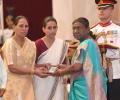
President Droupadi Murmu conferred 26 Shaurya Chakras (seven posthumous) to personnel of the armed forces, Central Armed Police Forces and state/Union Territory Police during a defence investiture ceremony.

The Kirti Chakra and Shaurya Chakra were posthumously awarded to Major David Manlun and Major Satish Dahiya, who lost their lives while fighting with terrorists in Nagaland and Jammu and Kashmir.

Helicopter Pilot Wing Commander Deepika Misra rescued 47 people in an operation that lasted 8 days in flood-ravaged Madhya Pradesh.

Seeking to put a lid on fresh controversy over movement of two army units near Delhi in 2012, Defence Minister A K Antony has said that the Indian military is a responsible force, which obeys the civilian government's decisions and in no circumstances there will be a military coup in the country.
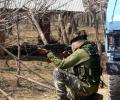
Two top Army commanders on Saturday said the fresh ceasefire between India and Pakistan will have no bearing on the counter-terrorism operations in Jammu and Kashmir and that the force will exercise 'maximum restraint' in the event of any violation by the neighbouring country.

While Indian Air Force ace pilot Group Captain Abhinandan Varthaman was accorded the Vir Chakra, Army Major Vibhuti Shankar Dhoundiyal, who was killed in the 2019 Pulwama terrorist attack, was accorded the Shaurya Chakra (posthumously) by President Ram Nath Kovind in an investiture ceremony on Monday.

Shaurya Chakra is usually awarded to armed forces and para-military personnel for 'gallantry otherwise in the face of the enemy'.
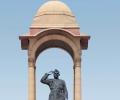
Till the statue, made of granite, is completed, a hologram statue of his would be present at the same place.

'In the 1971 War my battalion suffered 4 casualties after fighting for 14 days.' 'In Operation Blue Star, I lost 19 men in just one hour.'

Never before in post-reforms India have Union Budgets seen a steady reduction in fiscal deficit for five consecutive years, points out A K Bhattacharya.
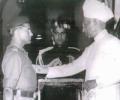
Decorated with a Vir Chakra for leading an attack that destroyed four tanks, Risaldar Ayub Khan shared a name with the Pakistani president who ordered the invasion of India in 1965. India's Ayub came from a family of soldiers and made his country proud.

An insecure political class, with little knowledge of the military, has unquestioningly internalised the fear that a powerful tri-service chief would threaten democracy, says Ajai Shukla.

'I realised what a great leader he was by the way he took decisions to undertake the most-risky of missions.'
